


12 Apr How to Plan Efficient Travel Routes Across Europe: The Ultimate Guide to Saving Time, Money, and Stress
Imagine this: You’ve dreamed of exploring Europe’s iconic cities, only to find yourself stuck in a train station, missing a connection, or blowing your budget on last-minute flights. A Skyscanner study found that 68% of travelers regret not planning their routes more efficiently, leading to wasted time, unexpected costs, and missed experiences. The culprit? Poorly optimized European travel routes that ignore the continent’s unique geography, transport options, and seasonal quirks.
The truth is, Europe’s proximity and interconnected transport networks make it the perfect place for multi-city itineraries—if you plan them right. Yet, most travelers either overpack their schedules or miss key connections, turning what should be a seamless adventure into a logistical nightmare. This guide isn’t about cramming as many cities as possible into your trip. It’s about crafting a route that balances efficiency, budget, and experience, so you spend less time in transit and more time exploring.
You’ll learn how to leverage Europe’s transport hubs, avoid common routing mistakes, and design a multi-city itinerary that flows smoothly from one destination to the next. By the end, you’ll have a blueprint to turn your European adventure into a well-oiled journey that maximizes your time and budget.
The Hidden Costs of Poorly Planned Europe Travel Routes
The Time Trap: How Inefficient Routes Eat Up Your Vacation
A Eurostar survey revealed that travelers waste an average of 12 hours per trip due to poor route planning—time spent waiting for delayed trains, backtracking between cities, or stuck in transit hubs. Europe’s compact size means you can visit multiple countries in a single trip, but only if you plan your routes logically. Jumping from Madrid to Prague to Rome might seem exciting, but the backtracking and extra travel time will drain your energy and budget.
Example: A traveler who routed Paris → Barcelona → Milan → Vienna spent 20 hours in transit, while a smarter route (Paris → Milan → Vienna → Budapest) would have cut travel time in half.
The Budget Drain: How Last-Minute Bookings Inflate Costs
Transport prices in Europe fluctuate dramatically based on demand. A Trainline report found that booking train tickets just one week in advance can cost 50% more than booking a month ahead. Flights, buses, and even ferry prices follow similar patterns. Without a clear route plan, you’ll end up paying premium prices for suboptimal connections.
The Stress Spiral: How Poor Planning Ruins the Experience
A Booking.com study found that 45% of travelers cite transportation issues as their biggest source of stress. Missed connections, overpacked schedules, and unclear directions turn what should be an adventure into a series of frustrations. Efficient Europe travel routes eliminate this stress by building in buffer time, logical connections, and backup options.
The Opportunity Cost: How Bad Routes Mean Missed Experiences
Rushing between cities to “see it all” often means you experience very little. A Condé Nast Traveler survey revealed that travelers who spent at least three nights in each destination reported 30% higher satisfaction rates than those who hopped cities every other day. Well-planned routes allow you to dive deeper into each location, rather than skimming the surface.
How to Plan Efficient Travel Routes Across Europe: A Step-by-Step Guide
Step 1: Define Your Trip Goals and Priorities
Before mapping your route, clarify what you want from your trip:
- Cultural exploration: Museums, historical sites, and local traditions.
- Nature and adventure: Hiking, beaches, or national parks.
- Food and wine: Culinary hotspots and vineyard regions.
- Budget constraints: Prioritizing affordable destinations and transport.
- Pace: Fast-paced city-hopping vs. slow, immersive travel.
Example: A food-focused trip might route through Lyon, Bologna, and San Sebastián, while a nature lover’s itinerary could include the Swiss Alps, Slovenian lakes, and Croatian coast.
Step 2: Research Europe’s Transport Hubs and Corridors
Europe’s transport network is a web of hubs and spokes. Plan your route around major connections:
- Air: Frankfurt, Amsterdam, Paris, and London are the continent’s biggest air hubs.
- Rail: Paris, Brussels, Frankfurt, and Zurich are central rail junctions.
- Road: The E-road network connects major cities by highway.
- Ferries: Hubs like Barcelona, Athens, and Dubrovnik link to islands and coastal destinations.
Pro tip: Use Rome2Rio to compare transport options between cities, including estimated costs and travel times.
Step 3: Choose a Logical Route Pattern
Avoid zigzagging across the continent. Instead, follow a logical path:
- Loop routes: Start and end in the same city (e.g., London → Paris → Amsterdam → Brussels → London).
- Linear routes: Fly into one city and out of another (e.g., Barcelona → Madrid → Lisbon → Porto).
- Regional deep dives: Focus on one area (e.g., Italy: Rome → Florence → Bologna → Venice).
Example: A two-week trip could follow the Mediterranean loop: Barcelona → Marseille → Nice → Milan → Venice → Ljubljana → Zagreb → Barcelona.
Step 4: Balance Travel Time and Destination Time
Aim for a 1:3 ratio—one day of travel for every three days in a destination. Use this rule of thumb:
- Short trips (1-2 weeks): Limit to 3-4 cities.
- Medium trips (2-4 weeks): 5-7 cities.
- Long trips (1+ months): 8-10 cities, with longer stays in each.
Pro tip: Use Google Maps’ “My Maps” feature to visualize travel times between destinations.
Step 5: Book Transport in Advance for the Best Prices
Europe’s transport systems reward early planners:
- Trains: Book 1-3 months ahead on Trainline, Raileurope, or national rail sites (e.g., SNCF for France, DB for Germany).
- Budget flights: Use Skyscanner or Google Flights to track prices and set alerts.
- Buses: FlixBus and Eurolines offer affordable, last-minute options.
- Ferries: Book in advance for popular routes (e.g., Greece’s islands, Croatia’s coast).
Example: A Paris-to-Barcelona train ticket costs €39 if booked a month in advance but jumps to €99 if purchased a week before.
Step 6: Leverage Overnight Transport to Save Time and Money
Overnight trains, buses, and ferries kill two birds with one stone: you travel while you sleep, saving on a night’s accommodation. Popular routes include:
- Trains: Paris to Nice, Vienna to Venice, Berlin to Copenhagen.
- Ferries: Athens to Santorini, Barcelona to Mallorca.
- Buses: Berlin to Prague, Lisbon to Porto.
Pro tip: Book a sleeper cabin on trains or a private cabin on ferries for comfort.
Step 7: Use Regional Passes for Flexibility and Savings
Rail passes can save money if you’re taking multiple train trips:
- Eurail Pass: For non-Europeans; offers unlimited travel in up to 33 countries.
- Interrail Pass: For European residents; similar coverage to Eurail.
- Regional passes: E.g., Swiss Travel Pass, France Rail Pass, or Germany Rail Pass.
Example: A 10-day Eurail pass covering 4 countries costs €351, while individual tickets for the same route would total €500+.
Step 8: Build Buffer Time Into Your Itinerary
Delays happen. Protect your plans by:
- Avoiding tight connections: Allow at least 1-2 hours between trains/flights.
- Scheduling rest days: Every 5-7 days, plan a lighter day to recharge.
- Having backup options: Know alternative routes in case of strikes or delays.
Pro tip: Download offline maps and transport schedules using Google Maps or Citymapper.
Step 9: Pack Smart for Multi-City Travel
Efficient packing keeps you mobile. Stick to:
- One carry-on bag: Use packing cubes to organize clothes.
- Versatile clothing: Neutral colors that mix and match.
- Digital essentials: Offline maps, e-tickets, and translation apps.
Example: A 40L backpack with packing cubes lets you move quickly between cities without checking luggage.
Step 10: Use Technology to Streamline Your Route
Apps and tools make planning and navigating easier:
- Transport: Trainline, Omio, FlixBus, Skyscanner.
- Navigation: Google Maps, Citymapper, Maps.me (offline maps).
- Accommodation: Booking.com, Airbnb, Hostelworld.
- Itinerary management: TripIt, Google Trips, or a simple spreadsheet.
Pro tip: Create a shared Google Doc or Trello board to collaborate with travel companions.
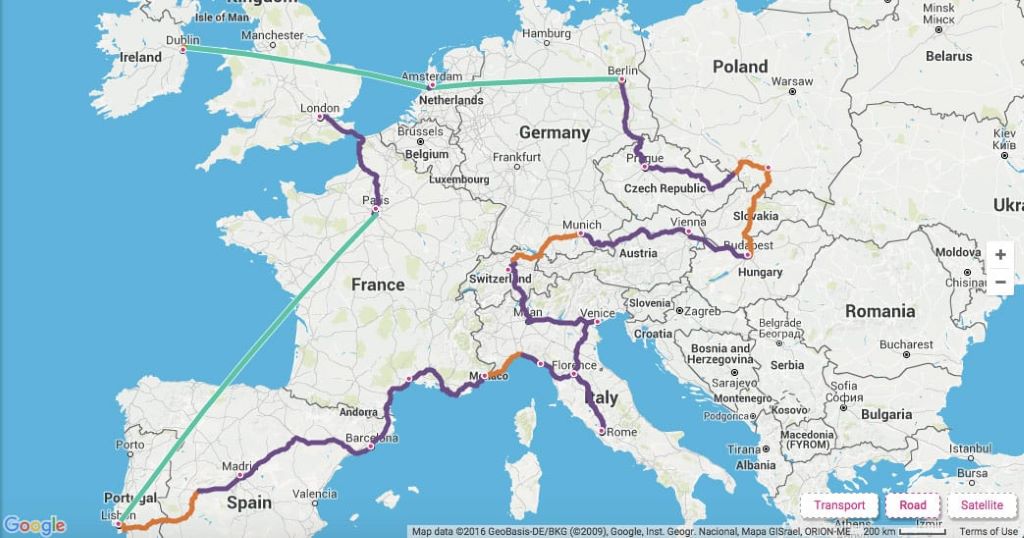
Multi-City Itinerary: Sample Routes for Different Travel Styles
Route 1: The Classic Grand Tour (2 Weeks)
Destinations: London → Paris → Amsterdam → Berlin → Prague
Transport: Eurostar (London-Paris), Thalys (Paris-Amsterdam), ICE train (Amsterdam-Berlin), RegioJet (Berlin-Prague).
Why it works: Major cities with excellent rail links and diverse cultural experiences.
Route 2: Mediterranean Coastal Adventure (10 Days)
Destinations: Barcelona → Marseille → Nice → Cinque Terre → Florence
Transport: Train (Barcelona-Marseille), bus (Marseille-Nice), train (Nice-Cinque Terre-Florence).
Why it works: Stunning coastal scenery with short, scenic train rides.
Route 3: Eastern Europe Deep Dive (3 Weeks)
Destinations: Budapest → Bratislava → Vienna → Ljubljana → Zagreb → Sarajevo → Mostar
Transport: Mix of trains and buses (e.g., RegioJet, FlixBus).
Why it works: Affordable, underrated destinations with rich history and short travel times.
Route 4: Scenic Train Journey (1 Week)
Destinations: Zurich → Lucerne → Interlaken → Zermatt → Milan
Transport: Swiss Travel Pass for unlimited train, bus, and boat rides.
Why it works: Some of Europe’s most breathtaking landscapes, all accessible by train.
Route 5: Island-Hopping Adventure (10 Days)
Destinations: Athens → Santorini → Mykonos → Crete
Transport: Ferries (book in advance with Ferryhopper or Direct Ferries).
Why it works: Greece’s islands are best explored by ferry, with each stop offering a unique vibe.
Common Mistakes That Ruin Europe Travel Routes
1. Overpacking Your Itinerary
Trying to visit 10 cities in 2 weeks leads to exhaustion and superficial experiences. Focus on quality over quantity.
2. Ignoring Geographical Logic
Routing Madrid → Paris → Rome → Berlin adds unnecessary travel time. Plan a circular or linear path.
3. Booking Last-Minute Transport
Train and flight prices skyrocket as departure nears. Book at least 1-3 months in advance for the best rates.
4. Underestimating Travel Times
A 6-hour train ride eats up a full day when you factor in packing, transit, and settling in. Be realistic about what you can accomplish.
5. Skipping Buffer Days
No plan survives first contact with reality. Build in extra time for delays, jet lag, or spontaneous detours.
6. Overlooking Regional Transport Options
Not all cities are well-connected by high-speed rail. Research buses, ferries, and budget airlines for gaps.
7. Forgetting About Visa Requirements
Schengen Zone rules allow 90 days in 180 for most travelers, but non-EU citizens may need visas for certain countries.
Expert Insights: How to Optimize Your Europe Travel Routes
Insight 1: Travel During Off-Peak Hours
Avoid Friday evenings and Sunday nights, when trains and roads are busiest. Midweek, midday travel is often cheaper and less crowded.
Insight 2: Use Secondary Airports for Cheaper Flights
Flying into Beauvais (Paris), Ciampino (Rome), or Charleroi (Brussels) can save €50-€100 per flight.
Insight 3: Mix Transport Types for Efficiency
Combine trains, buses, and budget flights to optimize time and cost. For example, take a night train from Vienna to Venice, then a budget flight to Athens.
Insight 4: Leverage Local Knowledge
Ask your accommodation host or a local tour guide for routing advice. They often know shortcuts, hidden gems, and transport hacks.
Example: A hostel owner in Prague might recommend a lesser-known bus route to Český Krumlov that’s cheaper than the train.
Insight 5: Consider Slow Travel for Deeper Experiences
Spending 4-5 days in each destination lets you explore beyond the tourist trail and build relationships with locals.
Insight 6: Use a Multi-City Flight Ticket
Airlines like Lufthansa, KLM, and Air France offer multi-city tickets that can be cheaper than booking separate flights.
Example: A multi-city ticket from New York to Paris, then Rome to New York, might cost less than two round-trip tickets.
Insight 7: Track Transport Price Trends
Use Google Flights’ price tracking or Skyscanner’s “Whole Month” view to find the cheapest days to travel.
Related Topics:
FAQs: Your Top Questions About Planning Efficient Europe Travel Routes
1. How many cities should I visit in a 2-week trip?
Aim for 3-4 cities to balance exploration and travel time. Example: Paris (4 days) → Amsterdam (3 days) → Berlin (4 days) → Prague (3 days).
2. What’s the best way to travel between European cities?
Trains are best for short-to-medium distances (under 6 hours). Flights save time for longer jumps (e.g., Barcelona to Istanbul). Buses are budget-friendly but slower.
3. How far in advance should I book trains and flights?
Book trains 1-3 months ahead for the best prices. Flights are cheapest 2-4 months in advance, though budget airlines (e.g., Ryanair, EasyJet) can have last-minute deals.
4. Is a Eurail Pass worth it for my trip?
Calculate the cost of individual tickets vs. the pass. A pass is worth it if you’re taking 4+ train trips over 500 km each.
5. How can I avoid jet lag when hopping between time zones?
Adjust your sleep schedule 2-3 days before departure. Stay hydrated, avoid alcohol, and get sunlight upon arrival to reset your circadian rhythm.
6. What’s the best way to handle money across multiple countries?
Use a no-foreign-transaction-fee card (e.g., Revolut, Charles Schwab). Withdraw local currency from ATMs to avoid poor exchange rates.
7. How do I plan a route that includes both cities and nature?
Combine urban hubs with nearby natural escapes. Example: Munich (3 days) → Berchtesgaden National Park (2 days) → Salzburg (2 days) → Vienna (3 days).
Conclusion: Turn Your European Adventure Into a Seamless Journey
Planning efficient Europe travel routes isn’t about cramming as many destinations as possible into your trip. It’s about designing a multi-city itinerary that flows logically, balances travel and exploration time, and aligns with your interests and budget. By leveraging Europe’s transport networks, booking strategically, and building in flexibility, you’ll spend less time in transit and more time creating memories.
Remember: The best routes are those that allow you to immerse yourself in each destination. Start with one of the sample itineraries in this guide, then customize it to fit your travel style and priorities. The more you plan, the more spontaneous and enjoyable your trip will be.
Your next step? Open a map of Europe and sketch out a rough route based on your top 3-4 destinations. Use Rome2Rio to compare transport options and estimate travel times. The perfect European adventure begins with a well-planned route.
Ready to Plan Your Dream European Trip?
Pick one destination from your bucket list and research its transport hubs. Then, use the tips in this guide to add 1-2 logical stops before or after. The more you refine your route, the smoother your journey will be.
Your efficient, stress-free European adventure starts with a smart route.